AI Discovery: Retailers Are Reshaping AI Shopping
OTTO, Ulta Beauty, and Google are reshaping AI shopping. What's changing in product search? How can retailers ensure their visibility?

OTTO is making 19 million products accessible through ChatGPT. Ulta Beauty is even offering discounts to customers who use AI to discover products. These examples show how the competition for product visibility is changing – and why retailers and brands need to take a closer look at their product data now.
The next shopping journey at OTTO might not start on OTTO's website at all. It could begin in ChatGPT.
In October, the Hamburg-based online retailer introduced its own ChatGPT plugin, allowing customers to explore and get recommendations on more than 19 million products. Users can install the plugin through ChatGPT's plugin directory and start a conversation by typing "@OTTO."
Someone looking for a quiet coffee maker under €200, for example, can describe their requirements in a conversation with AI and receive recommendations from OTTO's product catalog. The actual purchase still takes place on otto.de.
Behind the scenes, the integration uses an API built on the open Model Context Protocol (MCP), which provides a standardized way for external AI systems to connect with the retailer's infrastructure. Over time, this could allow AI agents to retrieve real-time prices and inventory information or handle additional steps in the shopping process.
OTTO is effectively bringing its product catalog directly into the AI applications where customers research products, compare options, and make purchasing decisions.
Ulta Beauty Takes It a Step Further
is pursuing a similar approach. Customers can use its ChatGPT plugin to discover products and receive personalized recommendations. Based on individual preferences, beauty goals, and budgets, the AI puts together relevant product bundles from Ulta's own catalog.
Ulta is also giving customers a financial incentive: a 10% discount on eligible, regularly priced products discovered through the plugin. The goal is to get customers comfortable with AI product discovery early on. Their shopping cart is then transferred to Ulta's online store or app, where checkout takes place.
Ulta has already gone a step further with Google. In Google's AI Mode and the Gemini app, customers can complete purchases directly within the AI experience using the Universal Commerce Protocol (UCP).
Other Retailers Got an Earlier Start
In October 2025, Walmart announced a partnership with OpenAI designed to let customers shop through ChatGPT. Target launched a beta app within ChatGPT in November 2025, and Sephora followed in March with an in-app experience offering personalized beauty advice, access to Beauty Insider profiles, and perks such as samples and free shipping.
All these initiatives share one objective: retailers want to reach customers wherever their product searches begin. To do that, they're experimenting with new ways to provide shopping assistance, simplify purchases, and offer incentives.
The Digital Shelf Is Gaining a New Layer
For years, the e-commerce industry has talked about the digital shelf: the online space where products gain visibility, compete for attention, and eventually get purchased. It includes product detail pages on a retailer's own website, search results, and product placements on Amazon, OTTO, and other marketplaces.
AI discovery adds another dimension to how products are selected and presented on the digital shelf.
With AI commerce, part of the customer journey is shifting to AI-powered systems. Shoppers can now describe what they need in natural language, without browsing categories, applying filters, and comparing dozens of product detail pages:
"I'm looking for a quiet coffee maker that doesn't use much electricity and costs no more than €200."
The AI assistant translates that request into specific product requirements: noise level, energy consumption, and price. It then needs to identify and compare products that meet those criteria. If a product is missing information about energy consumption or noise levels, it may be overlooked.
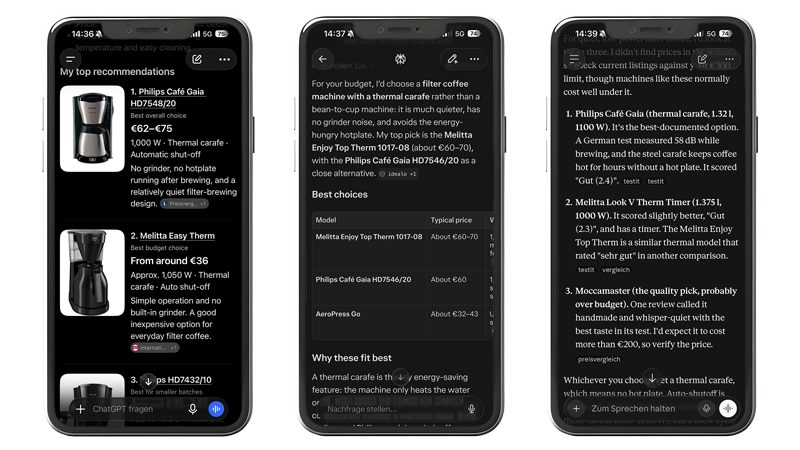
Until now, retailers and brands have primarily focused on ranking as high as possible in search results and product listings. Today, they face an additional question: Will an AI assistant recommend their product at all?
Visibility now depends on rankings, keywords, and paid placements, and also on how well AI systems can understand a product and match it to a customer's specific purchase intent.
The difference matters. A traditional search engine displays a list of results. An AI shopping assistant can narrow those results down to a handful of specific recommendations. Which products make the cut depends on the customer's context, the available product information, and the search and recommendation systems involved.
A strong position on a retailer's category page doesn't guarantee visibility in an AI conversation.

Do you know where your products are visible and where they're not? Digital Shelf Analytics gives you a clear picture of your competitive position and highlights opportunities for improvement.
There's also the technical question of how AI agents access product information and commerce functionality. Alongside MCP, new standards are emerging to support checkout. OpenAI and Stripe have introduced the Agentic Commerce Protocol (ACP), while Google has developed the Universal Commerce Protocol (UCP).
It's still unclear which standard will gain the most traction. Complete, structured, and up-to-date product data can make it easier for retailers to connect to different systems, although they'll still need to meet each protocol's specific technical requirements.
For retailers, this means AI discovery needs to be on the agenda across e-commerce, category management, product data management, and SEO. Companies taking this shift seriously should treat AI discovery as an additional sales channel with its own requirements for visibility and data quality.
AI Traffic: Still Small in Volume, but Growing in Influence
Early figures offer a glimpse of the potential commercial impact of conversational shopping assistance. OTTO reports that its voice-enabled AI assistant within its own online store already generates order values up to 37% higher than traditional search. Its conversion rate is also reportedly twice as high.
There are similar indications beyond individual retailers.
Similarweb's State of Ecommerce 2026 Report shows that customer journeys involving both AI and traditional search achieve a conversion rate of 23%. Journeys relying exclusively on traditional search convert at 17.3%, while AI-only journeys have a conversion rate of 12.5%.
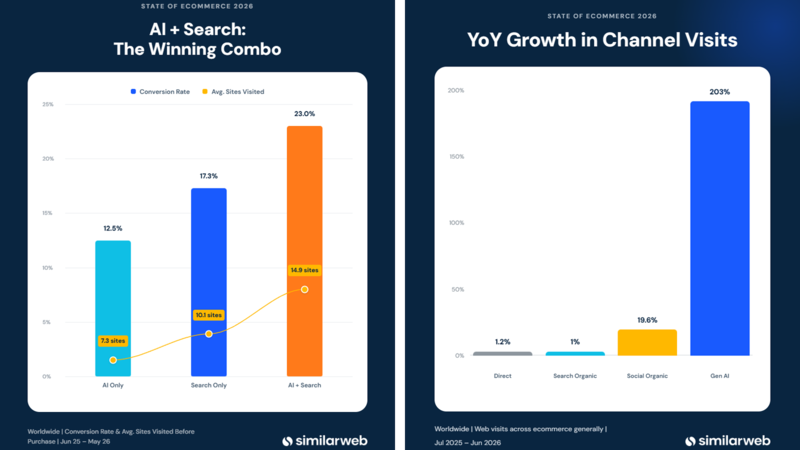
Customer journeys combining AI and traditional search perform best. This suggests that AI complements conventional product search and supports shoppers at different stages of their purchasing decisions. That said, these comparisons don't establish that AI itself causes higher conversion rates.
According to Similarweb, referrals from generative AI systems are growing rapidly, up 203% year over year. Yet they still account for only around 0.4% of total retail e-commerce traffic.
A 203% increase sounds like a major industry shift. A 0.4% traffic share sounds almost insignificant.
For retailers and brands, it would be premature to fundamentally rethink their existing commerce strategies. But it would be equally shortsighted to ignore AI discovery until it accounts for a meaningful share of revenue.
There's also a measurement challenge: referral traffic doesn't tell the whole story of AI's influence on purchasing decisions.
A customer might research products with an AI assistant and later visit a retailer through Google, a direct website visit, or a marketplace. In many analytics systems, that visit won't be attributed to AI. Put simply, AI may have influenced the purchase even though that interaction never appears in the retailer's web analytics.
With a traffic share of just 0.4%, calling AI discovery a dominant commerce channel would be an overstatement. Still, there are good reasons to start preparing now. Improving product data quality, building technical integrations, and establishing internal processes can't be done in a matter of weeks.
That's why OTTO is already investing in the technical infrastructure needed to connect its product catalog to AI systems. Whether the OTTO and Ulta Beauty plugins will noticeably affect revenue remains to be seen.

Are your competitors already benefiting from AI discovery? Find out which competitors are attracting traffic from AI applications and how traffic patterns are changing across your market.
Google's Universal Cart: What's Already Possible in the US
Since October 15, 2026, US consumers have been able to add products from multiple retailers to a single shopping cart directly within Google Search and the Gemini app.
According to Google, the cart saves products from different retailers, provides notifications about price drops and restocked items, displays promotional codes, and suggests a payment method based on Google Wallet information. Customers can pay through Google Pay within the cart or complete their purchase on the retailer's website. The retailer remains the seller of record and handles order confirmations and customer support.
This moves another part of the shopping journey into Google's own products. Customers can compare, save, and, in some cases, purchase products from multiple retailers without switching between online stores.
Google hasn't announced an EU launch. Still, developments in the US market illustrate why AI-supported shopping experiences deserve attention.
Salesforce estimates that AI and AI agents influenced $262 billion in global online holiday sales between November 1 and December 31, 2025. That's roughly 20% of the $1.29 trillion in worldwide online sales during that period. Salesforce's figures include retailers' own AI agents as well as external AI platforms.
According to Adobe Analytics, AI-driven traffic to US online stores increased 393% YoY in the first quarter of 2026. In March 2026, that traffic converted 42% better than other traffic sources. Just one year earlier, it had converted 38% worse.
Europe Can't Afford to Wait It Out
The fact that Google's Universal Cart is currently limited to the US gives European retailers some breathing room. How much time they have to prepare, however, remains uncertain. Agentic commerce has more drivers than Google alone.
Open protocols such as UCP and MCP enable different types of integrations, while retailers like OTTO are already developing their own solutions. It's impossible to reliably predict when specific features will become available in Europe.
That makes it all the more important to assess the technical foundations early: structured product data, accurate inventory levels, reliable pricing, and interfaces that allow AI systems to access this information.
Product Data Determines Visibility in AI Conversations
This brings a familiar e-commerce challenge back into focus: product data quality.
The information that has long been essential for effective search results and product detail pages matters even more for AI-powered recommendations.
AI can only compare and recommend products effectively if it knows their characteristics, understands what they offer, and can match them to a customer's requirements. A product title, three bullet points, and a generic marketing description often aren't enough.
Products need to be easy to identify, their relevant characteristics must be accessible in the data, and information such as pricing and availability must be current.
A useful way to assess readiness is the Agent Readiness Check, which looks at three levels:
| Level | Key Question | What to Check |
|---|---|---|
| Find | Can AI clearly identify and categorize the product? | Are all category-relevant attributes complete? Is a GTIN/EAN available? Is structured product data maintained using schema.org? |
| Understand | Can AI determine who the product is for and what it's suitable for? | Are specific dimensions, features, and use cases described? Are common customer questions answered? Is relevant information from customer reviews incorporated? |
| Act | Can an AI agent retrieve pricing and availability information and initiate a purchase? | Are current prices and inventory levels accessible? Are product variants clearly mapped? Are suitable technical interfaces available? |
Four Steps to Get Started
- Audit your 50 best-selling products. Check whether every product has all the attributes relevant to its category.
- Add specific use-case and audience information. Include verifiable facts and figures wherever they matter to purchasing decisions.
- Check pricing and inventory consistency. Make sure prices and stock levels match across your online store, product feeds, and marketplaces. Recommending an out-of-stock product frustrates customers and undermines trust in the channel.
- Review your technical integrations. Identify which existing or new interfaces could allow external AI systems to access your product catalog.
The following example of a drip coffee maker illustrates what this looks like in practice:
| Feature | Incomplete Data | AI-Ready Data |
|---|---|---|
| Product title | "Premium Coffee Maker" | "Drip Coffee Maker, 1.25 L, 18 cm Wide, 58 dB, for Small Kitchens" |
| Attributes | Color: Black | Color, width, height, capacity, noise level, wattage, material |
| Description | "Perfect for every home" | "At just 18 cm wide, it fits narrow countertops. Quiet enough for open-concept kitchens." |
| Product identification | No GTIN | GTIN/EAN and manufacturer part number included |
| Inventory | Updated manually once a day | Current, consistent pricing and inventory data available across the online store, feeds, and marketplaces |
The challenge grows with products that need additional explanation. Which skin types can tolerate a particular skincare product? What applications is a specific tool designed for? Which devices are compatible with a particular accessory?
Generic marketing claims are rarely enough to answer questions like these. AI systems need specific product characteristics, usage limitations, and compatibility information to make meaningful distinctions between products.
Brands often don't control the online store where AI will eventually recommend their products. Their greatest opportunity lies in the data they provide to retail partners.
That also increases the responsibility of manufacturers and brands. Providing accurate, consistent product information makes it easier for retailers to use that data across their online stores, product feeds, and AI integrations.
A well-written product description is not enough on its own. What matters is that the same information is also available as structured attributes that remain consistent across different sales channels.
For retailers and brands, this creates a shared responsibility: organizing product information so that both people and machines can use it reliably.

How well is your digital shelf performing? Our Digital Shelf Analytics solution helps you identify weaknesses in product visibility, content quality, and competitive positioning, so you can take targeted action to improve performance.
Building the Foundation for Visibility on the New Digital Shelf
High-quality product data is only one part of the preparation. OTTO's example shows that technical access to commerce systems is becoming increasingly important as well.
Over time, a static product catalog will fall short. Prices change. Products sell out. Delivery times vary by location. Product variants and availability information need to be mapped correctly.
An AI assistant that recommends an unavailable variant or quotes an outdated price creates a problem the retailer must fix. As AI agents take on more responsibilities throughout the shopping process, reliable interfaces and up-to-date data will become increasingly important.
The requirements extend beyond traditional product data management. Retailers need to ensure their commerce systems can provide information reliably and, over time, support actions initiated by AI agents.
For the foreseeable future, most customers will continue to research and complete purchases through familiar online stores, marketplaces, and search engines.
There are also open questions about how AI platforms will prioritize product recommendations, what role paid placements will play, and how much control retailers and brands will retain over their visibility.
For now, a practical starting point is to assess the current state of your product data and systems.
- How complete is your product data?
- Are relevant product attributes maintained consistently?
- How accurate and up to date are your prices and inventory levels?
- Can this information be made available to new applications through technical interfaces?
Brands should pay particular attention to the quality of the data they provide to retail partners. Even the most sophisticated AI shopping experience can't reliably compensate for missing or contradictory product information.
So preparing for AI commerce is a cross-functional effort involving product data management, content teams, IT, and collaboration between brands and retailers. Companies that already have strong foundations in these areas will find it easier to expand into new AI-powered sales channels.
OTTO and Ulta Beauty show that some retailers are already actively developing this emerging channel. They're gaining hands-on experience with new approaches to product discovery and personalized shopping assistance today, ahead of AI shopping going mainstream.
How large this new layer of the digital shelf will become, and which platforms will end up leading the market, remains uncertain. One thing already stands out: product discovery and purchasing decisions can increasingly take place outside traditional retail platforms.
Retailers and brands should know whether their product data and systems are ready to support AI platforms, even before deciding which ones to join.
If AI assistants increasingly influence which products customers see in the first place, data quality will become a prerequisite for visibility. Companies that wait until then to prepare could lose valuable time.
Discover your biggest digital shelf opportunities. In a personalized demo, we'll show you how to systematically analyze product visibility, content quality, and competitive performance.

FAQ: Agentic Commerce, AI Discovery, and the Digital Shelf
What Is Agentic Commerce?
Agentic commerce refers to online shopping experiences in which AI agents research and compare products and increasingly handle tasks throughout the purchasing process. With OTTO and Ulta Beauty, checkout currently takes place in the retailers' own online stores. Other solutions already support checkout directly within the AI environment. How independently an AI agent can operate depends on the underlying technical integration.
How Is AI Discovery Changing Product Search?
AI discovery allows customers to search for products by describing their specific needs in natural language. Shoppers describe what they need and receive a curated selection of relevant recommendations, with no manual filtering or page-by-page comparison. For retailers and brands, this creates another layer of competition for visibility. What matters is whether AI systems can find their products, understand their characteristics, and match them to customer requirements.
How Can Products Become Visible in ChatGPT and Other AI Systems?
The foundation is accessible, detailed product information. This includes structured attributes, unique product identifiers, and descriptions of specific use cases. Depending on the platform, product feeds, search indexes, or direct technical integrations may be used. Which products get recommended is determined by each platform's search and recommendation systems. Complete product data improves the chances of being considered, but it doesn't guarantee placement.
What Product Data Do AI Agents Need?
AI agents need complete, unambiguous, machine-readable product data. This includes category-specific attributes such as dimensions, materials, performance specifications, and compatibility information, along with unique identifiers such as GTIN/EAN and current pricing and availability. Detailed use-case information helps AI systems match products to customer needs. Structured data based on schema.org can also support machine processing.
How Can Digital Shelf Visibility Be Measured?
Digital Shelf Analytics helps retailers and brands systematically evaluate their product presence across relevant retail platforms. This includes metrics such as search rankings, content quality, product availability, and competitive positioning. Additional analysis of AI referral traffic can reveal how new pathways to online stores are developing. Visibility within AI-generated recommendations needs to be evaluated separately.
How Can Retailers and Brands Prepare Their Products for Agentic Commerce?
A good starting point is to audit key products for complete attributes, unique identifiers, and consistent information. Retailers should then review pricing, inventory data, and technical interfaces. Brands should ensure their retail partners receive current, sufficiently detailed product information. Digital Shelf Analytics can help identify weaknesses and prioritize improvements where they'll have the greatest impact.