Why AI Agents See Your Product — and Still Recommend a Competitor
Learn how to connect product data to purchase intent and close gaps that hold AI shopping assistants back.

Two retailers sell the exact same washing machine: same model number, same price, give or take a few cents. A shopper asks an AI shopping assistant to find a quiet, compact machine for a small apartment. The shopping assistant recommends one of the two retailers: the one whose product data answers the shopper's question. Ad spend and review count play no role in that decision.
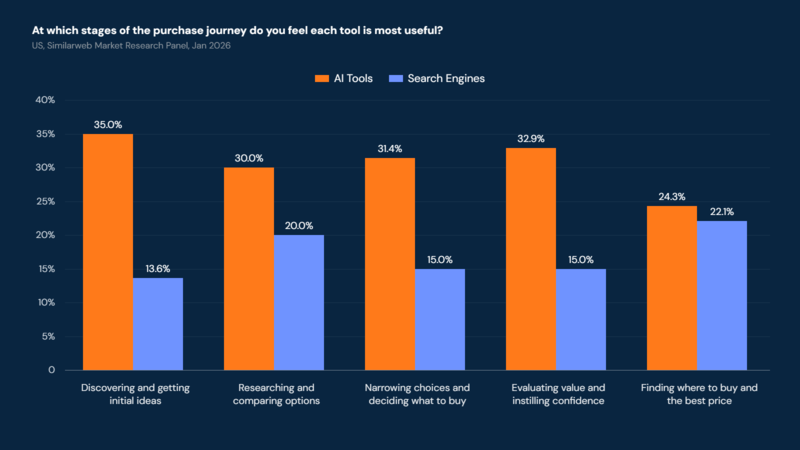
According to a McKinsey ConsumerWise survey, 68% of U.S. consumers had used at least one AI tool in the previous three months in 2026, regardless of the purpose. And Similarweb’s 2026 AI Brand Visibility Report confirms the importance of AI: According to the report, 35% of consumers use AI tools during the initial discovery stage of the purchase journey, compared to just 13.6% who use traditional search engines at that stage.
AI agents are already part of the purchase journey. Questions are answered in natural language, different products are compared, and recommendations are made based on information from the buyer's individual profile. However, people still complete most transactions themselves.
Recommendation Over Ranking
Optimizing product listings has never been particularly easy, but it involves a few simple steps: keyword research, aligning the keywords with the product’s USPs, and creating a listing that’s likely to convert.
But if you're still thinking primarily in terms of the keywords a page ranks for, you're missing the bigger shift. A shopping assistant evaluates every query from scratch and determines which offer most clearly matches the shopper's intent. "6 kg capacity" is a specification. Whether that specification makes a product suitable depends on context:
Who is buying it, and what do they need it for?
Complete attributes are only the starting point. Context and metadata connect product facts to purchase intent. Price, availability, shipping, and service complete the offer.
This article looks at what an AI shopping agent evaluates when comparing two identical products, how to systematically connect attributes to purchase intent, where the most common data gaps occur, and how Digital Shelf Analytics can help strengthen your own offer.
How an AI Agent Reads Your Product Offer
An AI shopping agent doesn't evaluate a product the way a person does, quickly scanning a page and responding to an appealing image. It reads structured data: SKU, category, price, availability, delivery time, return policy, count and nature of reviews, and the specific product specifications relevant to the query.
If one of those fields is missing or contains conflicting information, the product is less likely to be considered. From the agent's perspective, it becomes harder to evaluate with confidence, regardless of the product's actual quality.
According to Adobe Analytics, AI-generated traffic to U.S. retail sites grew 393% year over year in the first quarter of 2026, from January through March. In March 2026, that traffic also converted 42% better than traffic from other channels, setting a record.
An agent that contributes to conversions at that rate isn't making recommendations at random. It weighs which of the available offers presents the least uncertainty.
A Practical Example: How Product Data Shapes the Recommendation
A shopper asks for a "quiet washing machine for a small apartment." A product described simply as "washing machine, 6 kg" loses out to one whose data includes noise level in decibels, dimensions in centimeters, and an explicit indication that it is suitable for small spaces.
The machines themselves may be technically identical. But only one gives the shopping assistant enough information to confidently match it to the shopper's intent.
The practical takeaway: For each product category, identify the three to five attributes that most directly address common shopper needs. Then make sure those fields are complete, consistent, and machine-readable. To maximise your listings’ discoverability, you’ll need to write content that directly answers use-case questions, and is more closely tailored to the more conversational way people interact with AI tools.

How complete is your digital shelf, really?
XPLN’s Digital Shelf Analytics helps brands and retailers identify missing product attributes, inconsistent information, and gaps in critical product data. See where data quality issues could be limiting your products’ visibility.
Why Your Competitor Gets Picked
When two retailers offer the same product, a shopping assistant evaluates the offers on three levels:
- Which one best matches the shopper's intent?
- Which provides the most reliable pricing and availability signals?
- And which carries the lowest risk of producing a bad recommendation?
To an AI agent, identical products do not automatically mean equally suitable offers.
Price alone matters less than many retailers assume. What matters more is whether the information is current and consistent. A price that hasn't been reconciled with actual inventory for days, or a delivery time listed in the feed but missing from the product page, introduces risk.
The agent doesn't need to accept that risk when another seller provides cleaner, more reliable signals.
According to Salesforce, AI and agents influenced $67 billion in global sales during Cyber Week 2025. They were involved in 20% of all purchases through personalized product recommendations and conversational customer service.
This data is based on more than 1.5 billion shoppers across 89 countries. At that scale, every point of uncertainty can translate into real, lost recommendations.
So, what does this mean for your own offer?
If two listings are identical except for the quality of their data, the offer with the combination of attributes, context, and reliability signals that gives the agent the greatest confidence has the advantage, regardless of a simple price comparison.
That's good news for retailers investing in data quality. This is an advantage you can build systematically. And unlike price, it can't simply be undercut.
Connecting Product Data to Purchase Intent
An attribute only becomes a reason to recommend a product when it can be connected to a specific purchase intent. That requires more than a complete spec sheet.
Three layers determine whether a shopping assistant understands and recommends an offer:
- the facts themselves,
- the context that gives those facts meaning, and
- the signals that establish confidence in price and fulfillment.
Turning Product Features into Reasons to Recommend
Let’s call this the ACS model: Attribute, Context, Signal. It describes the three layers that turn raw product data into a reliable foundation for recommendations. The attribute provides the facts about the product. The context connects those facts to a specific purchase intent. And the signal shows whether the right product is available, can be delivered, and is offered at the stated price. Only when all three work together does an offer become something an AI agent can not only understand but confidently match to a specific query.
The model helps brands and retailers assess product data not just for completeness, but for its recommendation readiness. This makes it easier to pinpoint why a product that is technically a good fit may still fail to get recommended.
The Attribute describes what the product is and what it can do.
Attribute is the specification itself: dimensions, weight, material, or technical metrics. This information needs to be machine-readable, clearly labeled, and consistently implemented using Schema.org or a comparable form of structured markup. That's the foundation. But as the washing machine example demonstrates, it isn't enough to earn a recommendation.
The Context explains who the feature matters to and when it is relevant.
Context connects the attribute to an intent. "6 kg capacity" only becomes meaningful when it's clear that this may be sufficient for a one-person household but not for a family of four. Metadata such as target audience, use case, location, or comparison category provides the context a shopping assistant needs to connect a feature to a question.
The Signal shows whether the right offer is available.
Signal includes price, availability, delivery time, and service. These factors determine whether a technically suitable product is available, reliably deliverable, and fairly priced. When an agent must choose between two otherwise equivalent offers, these signals carry significant weight because getting them wrong creates the greatest risk of undermining trust.
Only when these three layers work together does product data become a reliable foundation for an AI-driven recommendation.
Ranking vs. Recommendation: How the Rules Are Changing
The difference between traditional search engine ranking and agent-based recommendation comes down primarily to how visibility is determined. While search engines rank pages for specific keywords, an AI shopping assistant evaluates each query from scratch to determine which offer best matches the shopper’s intent. Here’s how the two approaches compare:
Traditional Ranking (Keyword Thinking) | Agent-Based Recommendation (Intent Thinking) |
Optimizes for exact keyword matches Evaluates page authority and backlinks One ranking position per search term Goal: click-through rate Static competition for the #1 position | Optimizes for a clear connection between attributes and intent Evaluates data completeness and consistency at the SKU level One recommendation per specific user query, recalculated each time Goal: minimize uncertainty for the agent Continuous competition for every individual query |
One of the main advantages of AI tools over traditional search engine algorithms is that they can understand longer and more complex texts using natural language processing.
This allows you to create more natural and user-centric content that maximizes engagement with buyers while optimizing your products for AI-driven visibility.
If your optimization efforts to date have focused primarily on simple keywords, we recommend reviewing your product listings and making your content more natural and user-centric. This ensures that your content is as engaging as possible while also leveraging the powerful natural language processing capabilities of AI shopping assistants.
Visibility increasingly depends on whether your product data appears in the answer generated by the shopping assistant. Clicking through a list of search results is becoming secondary.

Go beyond individual product data with a complete view of your digital shelf
XPLN provides established Digital Shelf Analytics capabilities that help brands and retailers systematically monitor product data, pricing, and availability across retailers and marketplaces. Identify inconsistencies and data gaps before they affect product discoverability and recommendation readiness.
Where the Data Gaps That Hold Agents Back Come From
Most data gaps exist because a product page looks complete to a human while important information remains inaccessible to an automated system. This can happen even when a retailer otherwise maintains its product data carefully.
- Dimensions may be buried in a PDF spec sheet instead of stored in a structured field.
- Material information may exist only in the marketing copy.
- Configuration options may be visually selectable on the page without being represented as structured relationships in the underlying data.
The most common patterns can be turned into a simple checklist. Use it to assess your own assortment.
How good is your product presentation, really? This checklist will show you.
Are dimensions, weight, and materials stored in structured fields rather than only in body copy or PDFs?
Does the description specify the actual use case or target audience rather than simply listing technical specifications?
Does the displayed inventory match actual stock levels, and how frequently is the feed updated?
Is your category taxonomy consistent across all sales channels?
Are delivery times and return policies explicitly stated for each offer rather than appearing only as general information elsewhere on the site?
Does the price displayed on the product page differ from the price in the feed the agent actually accesses?
Each of these gaps may seem minor on its own. Together, however, they create the same problem we saw in the washing machine example: a technically equivalent product that the shopping assistant still doesn't recommend because the available data doesn't provide a clear enough answer to the shopper's intent.
How to Strengthen the Case for Your Offer
For a single product, these gaps can still be identified and fixed manually. Once an assortment spans multiple retailers, marketplaces, and countries, however, that process becomes the real bottleneck.
Who checks whether attributes, prices, and availability remain consistent and up to date across hundreds of listings? And how do you identify exactly where an individual retailer deviates from your standards?
XPLN monitors product data, prices, and availability across hundreds of retailers and marketplaces. The modular platform identifies where attributes are missing, prices are inconsistent, or inventory data appears outdated, using the same data layer an AI shopping agent evaluates when comparing two offers.
The same gaps that can lead a shopping assistant to recommend a competitor are exactly the gaps Digital Shelf Analytics can expose. Instead of manually reviewing every product page, brands and retailers gain an ongoing view of the attribute, context, and signal layers that differentiate two otherwise identical offers.
For teams that need to keep their assortment consistent across multiple sales channels and reliable for AI agents, this provides a natural complement to product data management within their own ecommerce environment.
Think in Intent, Not Just Keywords
AI-powered shopping assistants have not made traditional SEO obsolete. However, they have raised the bar for organic discoverability, making variables such as contextual information, customer reviews, and metadata more important than ever before.
The agent that could become your next customer doesn't read advertising copy or respond to a large media budget. It reads data, weighs uncertainty, and recommends the offer that most directly satisfies a specific intent.
That means two identical products can receive two entirely different recommendations based solely on the quality of their data.
Recommendation is the new ranking.
If you continue optimizing only for the keywords a page can rank for, you risk missing the broader shift toward recommendations. What increasingly matters is whether your offer can be understood and recommended.
By systematically connecting attributes to purchase intent and keeping pricing, availability, and delivery signals reliable, retailers can create an advantage that competitors can't simply undercut.
With Digital Shelf Analytics from XPLN, these factors can be systematically monitored and addressed across an entire assortment and across sales channels, before the next shopping assistant makes the decision for you.


Keep your digital shelf in view across every sales channel
Monitor product data, pricing, and availability across the online channels that matter to your business. Digital Shelf Analytics reveals where action is needed and provides the data foundation to position products reliably across traditional commerce channels and AI-powered product recommendations.